The Reject Pile Is the Real Chart: Dispatch from the UK Trade-In Desk
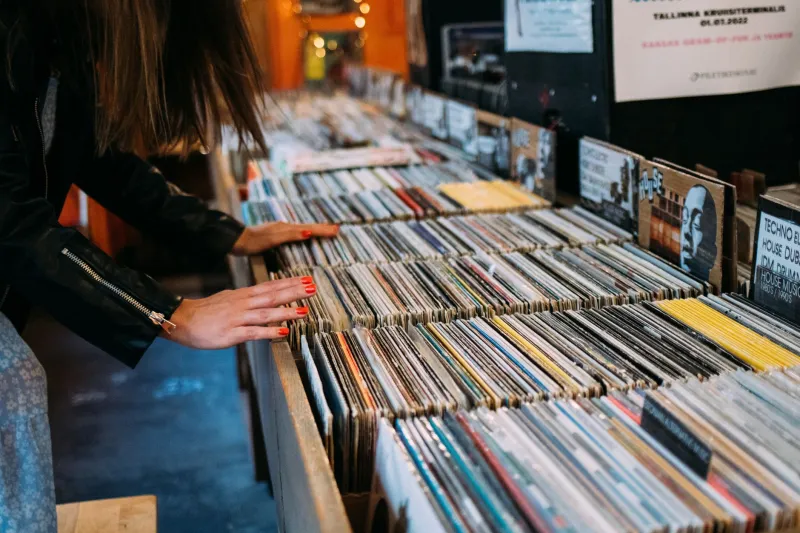
There's a sound a record shop makes on a Saturday afternoon that nobody ever puts on a field recording: the dry clack of a hundred sleeves being flicked past by someone who has already decided not to buy any of them. Behind the counter there's a second sound, softer — the thump of a collection being tipped out of a cardboard box that smells faintly of loft. That second sound is where the real story of British record buying lives in 2026.
I've spent the last few weekends loitering at trade-in counters in Leeds, Bristol and a basement shop in Glasgow that I'm not going to name because the owner already thinks too many people know about it. Not buying much. Just watching what comes through the door and, more importantly, watching what the staff do with it once it's out of the bag.
Two Crates and a Carrier Bag
The trade-in is the least glamorous part of the vinyl boom and the most honest. Anyone can sell you a reissue. Only a buy-back counter tells you what people in your town have stopped wanting, and they tell you at volume. A shop that takes in forty collections a month has a clearer picture of local taste than any algorithm, because nobody trades in a record they're still playing.
The sorting usually takes ninety seconds per box, and it happens in front of you whether you're meant to see it or not. There are three destinations. The wall — the good stuff, priced properly, sometimes cleaned. The box — decent, cheap, going out at three or four quid. And the bin, which is not always a literal bin. Sometimes it's a shelf under the counter for a car-boot job lot, sometimes it's a school fete, sometimes it's the recycling.
Watching that decision get made is the closest thing this country has to a public taste audit.
The Dad-Rock Surplus Has Not Gone Away
The volume of mid-seventies and eighties AOR coming through the door in 2026 is genuinely staggering. Every shop I stood in had a stack of the same titles waiting to be priced, and every shop had exactly the same problem: they already had four copies. Rumours, Brothers in Arms, Graceland, a couple of Queens, one optimistic Phil Collins.
This isn't a knock on the records. It's arithmetic. The people who bought them on CD between 1985 and 2000 are the same people clearing out now, and the shops can't sell fast enough to absorb it. The result is that a clean copy of something you'd have paid fifteen pounds for five years ago is now a two-pound box record, and a rough one doesn't get bought at all. If you're building a listening collection rather than a speculative one, this is your moment.
What surprised me more was the spillover. Soundtracks, classical box sets with the corners bashed, those enormous "The Best Of" compilations that take up half a shelf. Shops have quietly stopped taking them. One dealer told me he now refuses anything with more than four sides unless it's still sealed, and honestly, fair enough.
Dance 12s Have Hit a Ceiling — Sort Of
Every scene report about dance music in Britain has to mention that the 1990s 12-inch market is still running hot, and it is — but the trade-in counter shows the other side of that. Shops are being offered enormous quantities of the biggest-selling dance records and comparatively little of the rare stuff, because the rare stuff is still in the hands of people who know what it's worth.
What's landing: compilation 12s, white labels with no info, a lot of happy hardcore with the sleeves missing, hand-labelled drum & bass promos that may or may not play. What's not landing: anything that's been reissued twice already. A dealer in Bristol put it to me bluntly — if it's on Discogs for a fiver and there are ninety of them for sale, he'll take it as a favour and price it at three.
The upside for diggers is that this is where the accidental gold lives. Mixed boxes of 12s, thirty for twenty quid, are now standard, and the hit rate is somewhere north of what you'd expect because the shop hasn't got the hours to check every B-side.
The Surprises: Regional Folk, Indie Seven-Inches, Charity-Shop Staples
The stuff nobody predicted is the interesting part. Three shops mentioned a run on regional folk and privately pressed singer-songwriter LPs — the kind of records that sat in the folk section for a decade at eight pounds and are now being pulled out by people who've read one thread about them online. One shop had a handwritten note taped to the shelf reading "please do not re-sort — these are priced".
Indie seven-inches from the 2000s are moving in both directions. Shops are receiving them by the shoebox, and the ones with picture sleeves and a bit of mid-noughties mythology are going straight to the wall at a tenner. The rest go in the fifty-pence box, which is where the actual fun is.
And then there are the charity-shop staples: James Last, Val Doonican, brass band records, the Readers Digest sets. Shops take these because they come in bundles with things they want, then quietly move them on. Every one of those records is somebody's entry point and every one of those records will be back at a car boot by August.
How to Read a Shop's Cast-Offs Before They Hit the Bins
A few practical things I picked up, all of them free:
- Go midweek. The weekend brings the collections in; Monday and Tuesday is when they get sorted and priced. Turn up on Wednesday morning and the boxes are still warm.
- Ask what's 'not out yet'. Politely. Most staff will let you look at the un-priced pile if you're not a nuisance about it.
- Learn the shop's own discard shelf. Nearly every counter has a box of records they bought and then decided against shelving. It's usually the cheapest thing in the building and it turns over fastest.
- Read the multiples. Fourteen copies of one record means nobody wants it. Fourteen records by fourteen different artists from the same regional label means somebody's collection has just landed and nobody's had time to look it up.
- Check the geography. Local pressings, small regional labels and private presses get underpriced because they don't show up in the usual guides.
- Buy the bundle. If a shop is offering a box at a flat price and you can see six records you want, take the box. The rest is trade fodder and the shop will love you for it.
- Don't argue about condition. The dealer already knows. That's why it's in the two-pound crate.
The buy-back counter isn't a bin. It's a filter, and a fairly generous one. Everything that's ever been loved by somebody in this country passes through it eventually, and the shops are doing the sorting for free. All you have to do is turn up on a Wednesday and look.