Doors at Nine, Elbows at Nine-Oh-One: Field Notes from the UK Record Fair Circuit
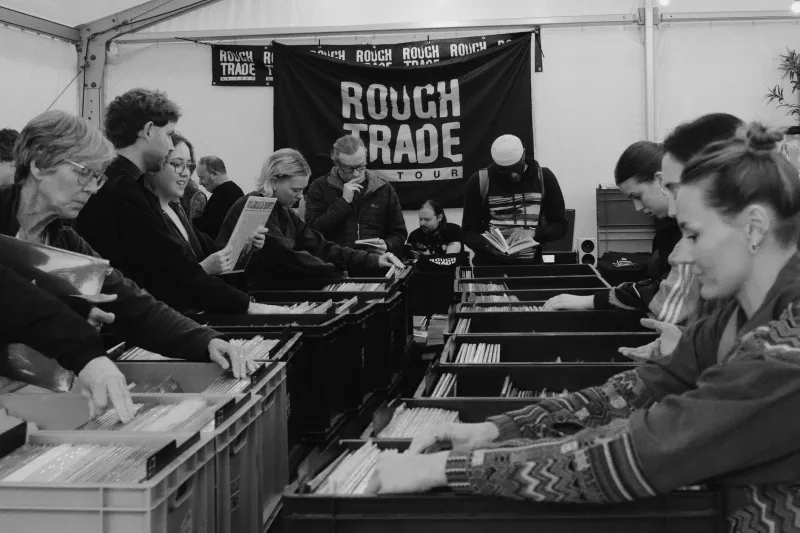
There is a moment, just after nine on a Sunday morning in a rugby club function room somewhere off the M62, when forty adults in sensible coats stop pretending they are not about to jostle for a copy of an obscure jazz-funk LP. The doors are open. The tea urn is still warming up. The entire fair will be decided in the next twelve minutes.
That is the part nobody puts on the flyer. The records are only half of it. The other half is a thick, unwritten code of conduct that you learn by getting it wrong in public, then coming back the following month to get it wrong slightly less. The UK record fair circuit — the church halls, the Labour clubs, the leisure centres with bad lighting and excellent burgers — is where crate-digging culture is actually taught. Shops are where you browse. Fairs are where you grow up.
The dawn queue is a social contract
Arrive at half eight and you will find a line of people who have already been there for forty minutes, standing in the cold with thermos flasks and tote bags folded under their arms. Nobody is chatting much. It is not unfriendliness. It is concentration. The queue is a pre-match huddle.
'The regulars know exactly where they are going before they get through the door,' says Janet, who has run a monthly fair in a Leeds church hall for eleven years. 'They have a map in their head. Table 14, second box from the left, the one with the blue tape. If you are behind them in the queue, you have already lost that record. That is the game.'
The etiquette is simple: don't ask what someone is looking for. Don't lean over them. Don't try to start a conversation about the weather when they are visibly running through a want list in their head. And if you are a first-timer, accept that you will spend the first twenty minutes watching other people's elbows and learning to move with them rather than against them.
The dealer hold: a favour, not a right
Here is where it gets delicate. You have found a record. You want it. But you have also spent your last tenner on a coffee and a dubious sausage bap, and the cash machine is three streets away. So you ask the dealer to hold it while you nip out.
There is a right way and a wrong way. The wrong way is to disappear for forty minutes and come back to find the record has been sold to someone with actual money. The right way is to leave something behind — a bag, a coat, a mobile number scrawled on the back of a receipt — and to be back inside five minutes.
'We hold for regulars, because we know they will come back,' says Dev, a Manchester collector who has been doing the circuit since the late nineties. 'But if you are a stranger and you ask me to hold a £40 record while you go to the cashpoint, I am going to say yes and then sell it to the next person who asks. That is not me being ruthless. That is me being realistic. The fair is only open for five hours.'
The compromise, according to the old hands, is the soft hold — you put the record on the table in front of the dealer, clearly separated from the rest of the stock, and you say: 'I'm having that. I'll be back in ten.' It is a statement of intent, not a request. It works about seventy per cent of the time.
The crate flick is a language
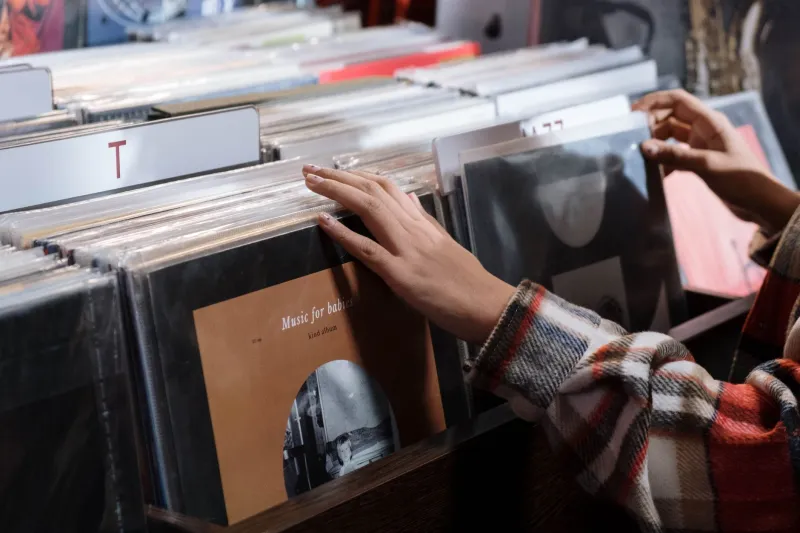
Watch a good digger work a crate. It is not a shuffle. It is a flick — thumb on the sleeve, forefinger lifting the record forward just enough to read the spine, then releasing. Fast, rhythmic, almost musical. The bad diggers use their whole hand. They leave gaps. They knock records out of sequence. They block the crate with their body so nobody else can get near it.
'The flick is about respect,' says Priya, who went to her first fair in Bristol last summer and now helps out on a stall. 'You are sharing a box with twenty other people. If you take ten minutes to go through forty records, you are holding up the whole line. The flick is how you say: I know what I am doing, and I am not going to waste your time.'
The other rule: put it back where you found it. Not in the jazz section if it is a soul record. Not at the front of the box because you are too lazy to find the right letter. Back where it came from. Every time. The dealer will notice, and they will remember you as someone worth talking to.
The haggling handshake
Haggling is allowed. Haggling is expected. But there is a line between a friendly negotiation and a public mugging.
The accepted opening is the bundle. You put three records on the table and say: 'What can you do on these?' The dealer names a price. You either accept it or you don't. If you don't, you put one record back and pay for the other two. That is the whole dance. It is not an auction. It is not a hostage negotiation. It is a quick, polite exchange between two people who both know the market.
What you don't do is haggle on a £3 record. What you don't do is offer half the marked price on a rare piece you clearly don't understand. What you don't do is walk away from a deal you have already shaken hands on because you found a cheaper copy two tables down. That last one will follow you around the circuit for years. The UK record fair community is bigger than it looks, and smaller than you think.
What the fair teaches that the shop cannot
A record shop is a curated space. Someone has already made decisions for you. A fair is the opposite: it is raw, chaotic, and entirely on you. You have five hours to work out what is worth your money, who is worth your time, and how to behave when the person next to you pulls out the exact record you have been chasing for a decade.
That is why the fair circuit still matters in 2026. Not because the records are cheaper — they often aren't. Not because the selection is better — sometimes it is, sometimes it is a room full of Cliff Richard. It matters because it is the only place where the culture is transmitted in real time, from one pair of elbows to the next.
'You can learn to dig online,' Janet says. 'You can watch videos. You can read guides. But you cannot learn the queue. You cannot learn the hold. You cannot learn to move out of someone's way when they are about to spend their rent money on a Blue Note first press. That only happens in the room.'
So go. Get there early. Bring cash. Keep your elbows in. And when you see someone flicking through a crate with the focus of a heart surgeon, don't interrupt. Just watch, and learn.