Boot Space and Back Rooms: Six Days on the Road With an Indie Distribution Rep

Photo by Photo by Anastasia Saldatava on Unsplash on Unsplash
The van is loaded by 7:40am and already too full. Forty copies of a Glasgow post-punk seven-inch, a dozen sealed copies of a Bristol dub reissue, two boxes of a Leeds label's new LP and a sad-looking tote bag of promo CDs that nobody asked for. Dean — a composite of the reps I rode with, name changed because his route is his livelihood — wedges a final box behind the passenger seat and mutters something about the M5.
This is independent distribution in 2026. Not a spreadsheet. Not a playlist pitch. A man with a diesel estate, a thermos and a list of shops that may or may not want what he's carrying. It is the most unglamorous part of the record trade and, for a small UK label, still the most reliable way in.
The Order Book Is the A&R Meeting
Dean works for a small distributor that handles around thirty labels. Some shift a few hundred copies a year; one or two might do a couple of thousand. His job is to get the records into shops, take the reorders, collect the returns and — crucially — tell labels the truth about what buyers are saying.
"People think A&R happens in a boardroom," he says, pulling into a Bristol side street. "It happens on a Tuesday morning when a buyer looks at a box and says, 'I'll take six, not twenty.' That's the decision. Six copies on a shelf in a shop that people actually walk into. That's the shot."
The economics are unromantic. A single LP might wholesale at £11 and retail at £24.99. A seven-inch wholesales around £4 and sells for £10. Shops work on 35–45% margin, sometimes more. Sale-or-return means the label carries the risk. Thirty-day terms are standard; sixty is generous; ninety is a favour you remember. Nobody is getting rich. The point is circulation.
What Buyers Actually Say
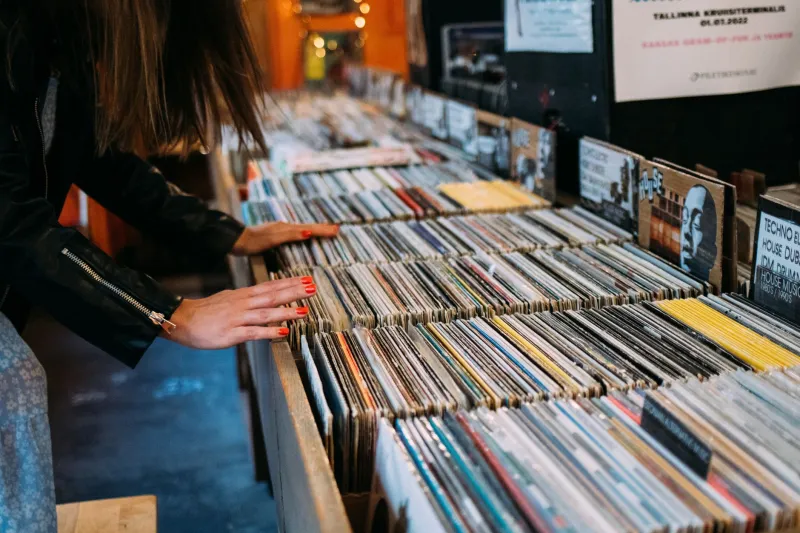
At the first stop, a cramped shop with a jazz section that smells of dust and coffee, the buyer barely looks at the records. She looks at the cover, turns it over, checks the barcode, checks the price, checks the label name.
"Who else has got this?" she asks.
Dean names two shops. She nods. "I'll take four."
That's it. Four copies. It sounds like nothing. But four copies in the right shop — a shop with a regular crowd, a shop where the staff actually play the records — can move faster than forty copies in a shop that files them alphabetically and forgets them.
"The buyers who survive are the ones who know their customers by name," Dean says later. "They're not buying for the nation. They're buying for the twelve people who come in every Saturday. If your record fits those twelve people, you're in."
Sale-or-Return Is a Handshake With Teeth
By lunchtime we've hit three shops and Dean has taken one reorder and one return. The return is a box of last year's pressing that never shifted. He doesn't argue. He loads it back into the van and updates the spreadsheet on his phone.
"Sale-or-return gets a bad reputation," he says. "Labels hate it because they don't get paid until the shop sells. Shops love it because they can take a chance. But it's the only reason a small label gets onto a shelf next to a major. The shop isn't risking cash. It's risking twelve inches of shelf space. That's the deal."
For a small UK label in 2026, that deal is everything. Pressing plants are busier than they've been in decades — the vinyl boom isn't slowing — but distribution is still the bottleneck. You can press a thousand records. Getting them into a hundred shops is a different job entirely. It requires a van, a route, a rep who knows which buyer likes dub and which one will take a punt on a cassette from Newcastle.
Why the Small Label Still Gets a Shot
Here's the part the streaming numbers don't tell you. A record shop is a physical filter. It is slow, human and stubbornly local. A buyer in Leeds doesn't care about your monthly listeners. She cares whether the record will sell to the people who come through her door on a wet Saturday. That's a harder test than an algorithm, and a fairer one.
Dean's route takes us from Bristol to Cardiff, up through Birmingham, across to Nottingham, Sheffield, Leeds, then Newcastle and finally Glasgow. Six days. Around forty shops. Some orders are two copies. Some are twenty. One shop takes a single copy of a record because the owner's mate is in the band. That copy will sell in a week.
"The labels that last are the ones that understand the route," Dean says. "They don't ring me up asking why they're not in every shop in London. They ask me which shops sold out and why. They build a relationship with the counter. That's the scene. That's always been the scene."
The Last Drop of the Day
On the final evening, in a Glasgow basement shop that doubles as a practice room, the owner takes eight copies of the post-punk seven-inch and asks Dean to pass on a message to the label: bring the band up for a gig. Dean writes it on his hand.
"That's the whole thing," he says, locking the van. "One box, one buyer, one gig. The route is the A&R. Always was."
If you run a small label, don't wait for the playlist. Find the rep. Print the barcode. Price it sensibly. Get in the van. The counter will tell you the truth.