Cut, Played, Gone: The UK Lathe Rooms Feeding the Dubplate Dance
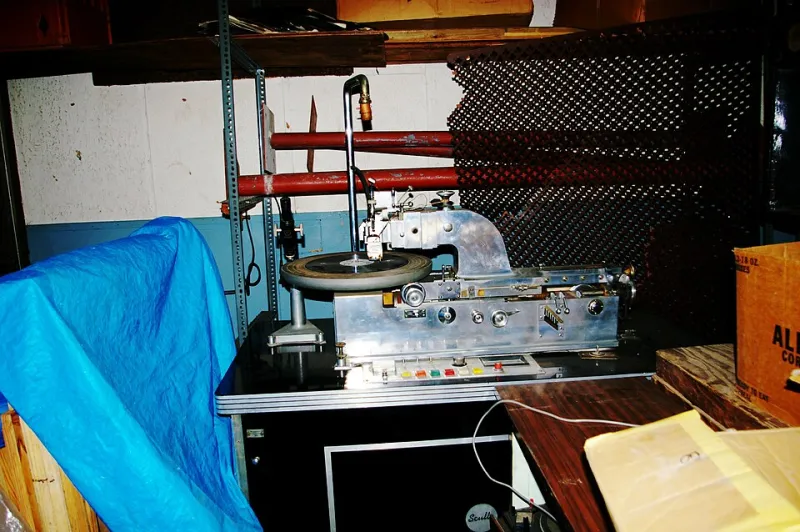
Photo: Christina Xu, CC BY-SA 2.0, via Wikimedia Commons
On a wet Tuesday in Bristol, the air in Marta Velez's basement smells of hot acetate and coffee. A lacquer disc is clamped to the lathe; a cutter head hums as it etches a groove that will exist exactly once. This is Ashgrove Lathe, one of a handful of UK cutting rooms still making one-off dubplates for soundsystem selectors, and the disc in question is destined for a Leeds reggae night on Saturday.
The lathe room smell
Velez has been cutting since the late 2000s, first as an assistant in London, then here in a converted cellar off Ashley Road. The room is small, warm and crowded with the good kind of clutter: test pressings, calibration discs, a microscope for checking groove walls, a shelf of half-finished dubplates in paper sleeves. In 2026, she says, the phone has not stopped. 'The soundsystem scene is healthy again,' she says. 'Not just London. Bristol, Leeds, Manchester, Glasgow. People want a disc that nobody else has.'
A dubplate is not a normal record. It is an acetate, cut in real time, one pass, no second chances. The engineer rides the levels, watches the chip fly off the disc, and hopes the bass does not push the cutter too hard. Get it right and the first play is enormous. Get it wrong and the whole room hears the distortion.
From blank disc to bass weight
The journey starts with a file or a dub. A selector sends a WAV, or turns up with a hard drive and a nervous expression. Velez checks the top and tail, asks about the intended venue, and sets the pitch. A dancefloor cut is not a hi-fi cut. It needs weight, but it also needs to survive a soundsystem stacked to the ceiling.
'You cut for the room, not for the headphones,' she says. 'A dubplate that sounds polite in here might sound thin in a club. You learn the difference.'
The cutting itself takes minutes. The preparation takes longer. There is a test play, a visual check, a label to write, a sleeve to sign. Then the disc goes into a padded bag and onto a train. By Friday night it is in Leeds, where Danny Kettle runs Kettle Cut, a small lathe service that supplies reggae and dub selectors across the north.
Kettle says the acetate is a commitment. 'A dubplate forces you to choose,' he says. 'You cannot carry a thousand of them. You carry six, maybe ten, and you know each one. The first play is the best play. By the tenth, you're hearing the room as much as the record.'
A dubplate's short life
That short life is the point. Acetates wear. The groove is soft compared with pressed vinyl, and every needle drags a little more music out of it. A dubplate that has been played all weekend may already sound dusty. A dubplate that has been played for a month may be a ghost.
Selectors know this. They file their dubplates like ammunition, mark them with dates and venues, and retire them when the crackle gets too loud. Some become souvenirs. Some get re-cut. Some are played one last time at a dance and then framed above a turntable.
'It is not a master,' Velez says. 'It is a snapshot. That is why people love it. It exists for a moment.'
That moment can be very specific. A dubplate special, a version, a vocal that only exists on one disc. In 2026, the UK circuit is full of them. Bristol's basement sessions, Leeds' reggae nights, London's soundsystem clashes: all of them run on a mix of digital files, pressed records and one-off acetates. The dubplate is not nostalgia. It is a working tool.
Why the format still matters
There is also the simple fact that a dubplate cannot be Shazamed. It cannot be bought on Bandcamp the next morning. It cannot be ripped from a stream. If you hear it in a dance, you have to remember it. That scarcity gives the format a charge that pressed vinyl cannot match.
Kettle thinks the revival is partly about sound. 'A good acetate has a texture,' he says. 'It is not clean. It is not perfect. It sits in the mix in a way that digital sometimes does not. The crackle becomes part of the tune.'
And partly, he says, it is about the object. 'People want to hold something. They want the label. They want the little white sleeve. They want to see the selector pull it out and know it is a one-off.'
The new generation of cutters is small but growing. Some work out of shared studios. Some cut in spare rooms. Some have learned from the older engineers and some have taught themselves from forums and YouTube. The equipment is old, the knowledge is passed hand to hand, and the waiting list can be weeks long.
The disc that wears out
Back in Bristol, Velez is finishing the Leeds disc. The lathe spins down. She holds the acetate up to the light to check the groove. It looks like a record and feels like a risk. On Saturday, it will be played loud. By Christmas, it will be worn. That is the deal.
'You do not make a dubplate to keep it safe,' she says. 'You make it to play it.'
In a scene that runs on exclusivity, that is the most exclusive thing of all: a piece of music that is designed to disappear. Cut, played, gone. The dancefloor gets it first, and then the format takes it back.